Longing and Belonging
Influences on The Tulip Poplars, Part I

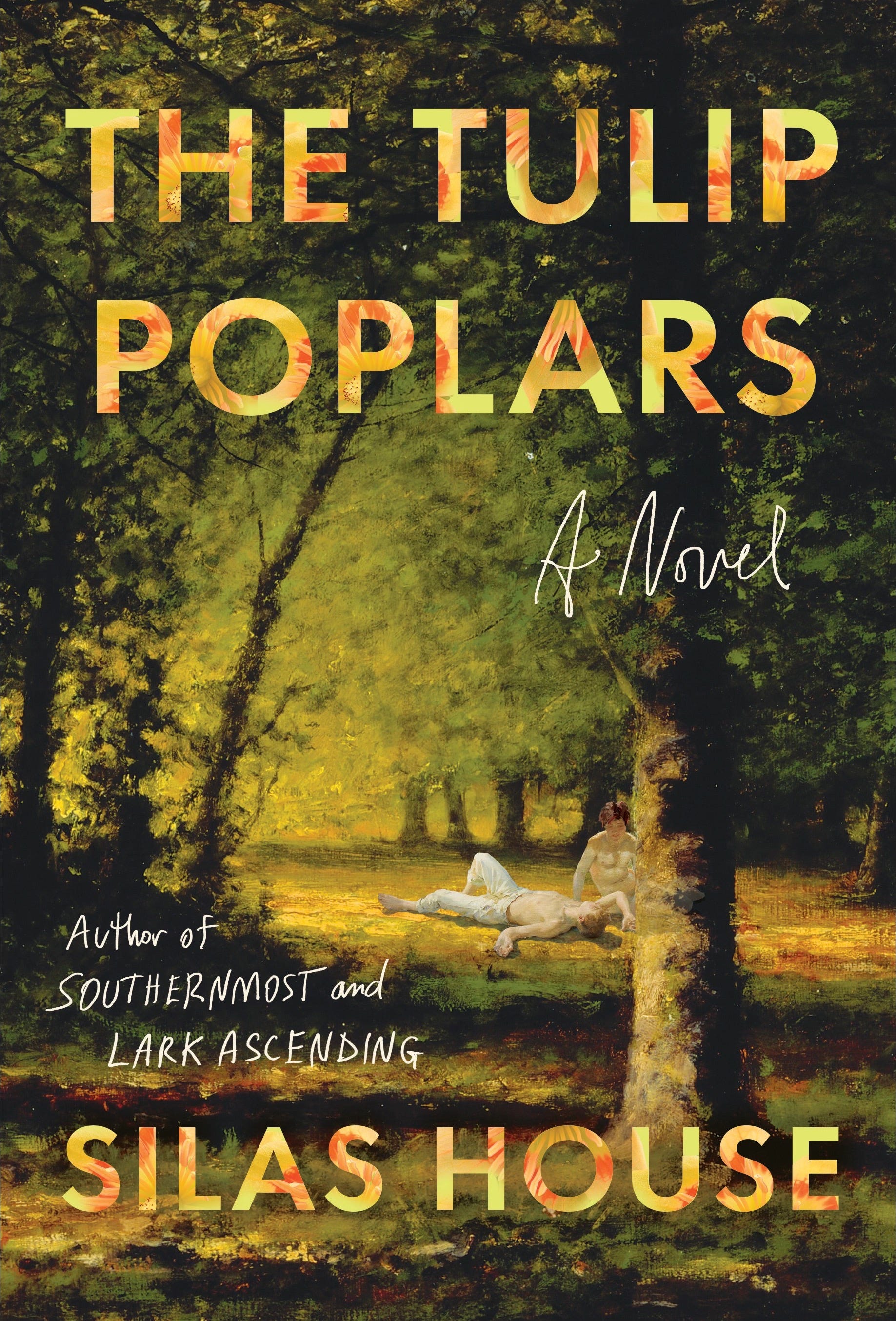
Note: We don’t have enough romance these days, so I wrote one. In my forthcoming novel, The Tulip Poplars, I follow two couples—one gay, one interacial—who are up against tremendous odds to be together. I always wanted to write a sweeping, epic story, and in The Tulip Poplars I finally managed to do it. In a series of posts between now and publication date (October 13) I’ll be talking about the influences and inspirations for the novel. This time I’m looking at The Welsh Girl by Peter Ho Davies and Madame Bovary by Gustave Flaubert. I welcome questions in the comments section.
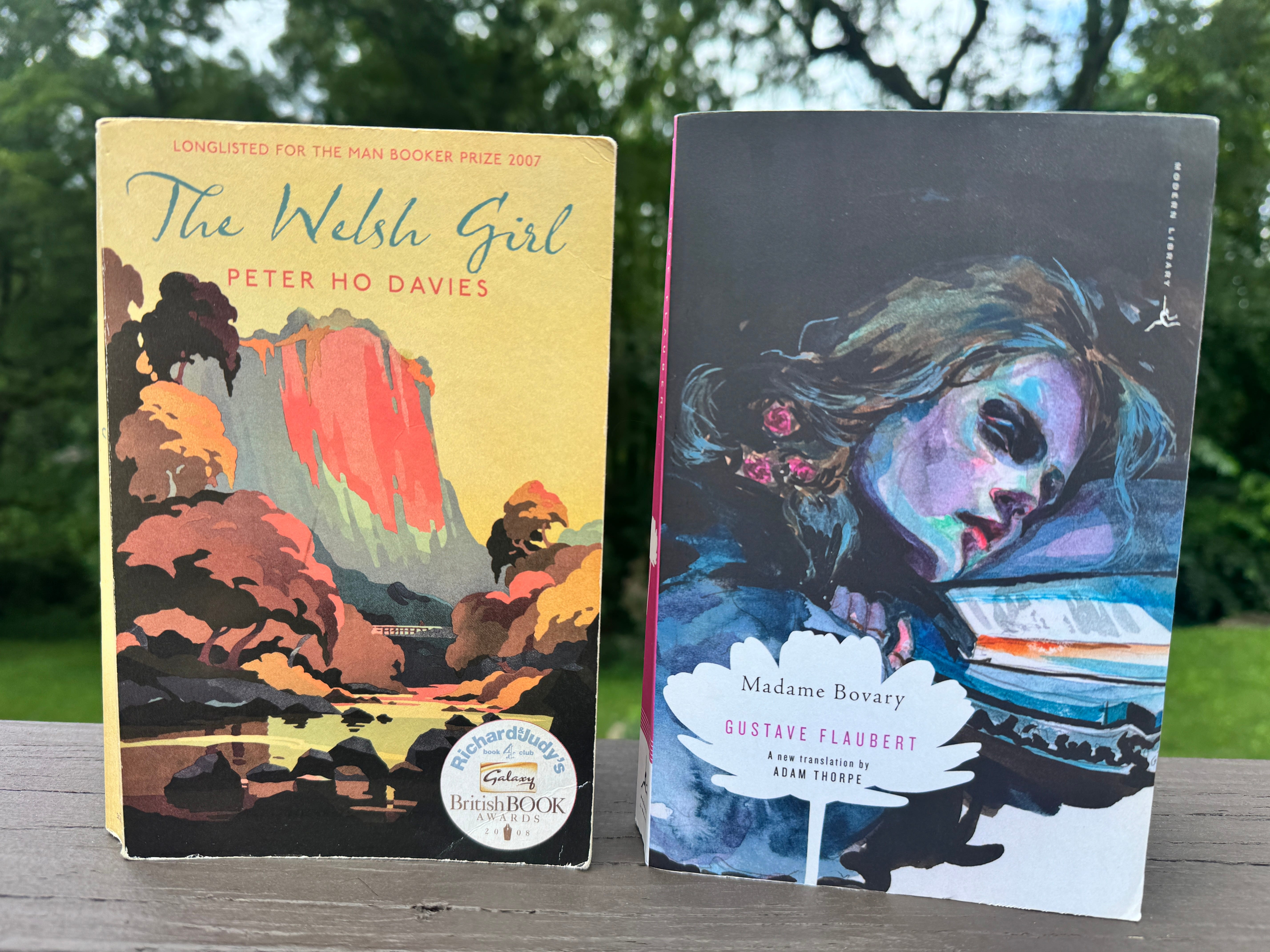
When I knew I was going to be able to write an epic love story like I had wanted to for years, I realized that I needed to read as many epic love stories as I could. Of course, when we say “love stories” we often mean books about deep longing, loneliness, and heartbreak even more than they are tales of living happily-ever-after.
When I’m working on a novel I often let the universe guide me to what I need to sustain me. Often this happens by pieces of art showing up in my life unexpectedly and repeatedly. A book that happened with was the Booker-longlisted novel The Welsh Girl by Peter Ho Davies. Published almost twenty years ago, in 2007, it kept popping up at many bookstores I visited and in social media posts by others. The last time this happened I was walking along the Thames in London, browsing at the many little wooden book bins that were set up down the promenade. There it was, again, but this time in its striking British cover. I liked the way it felt in my hands. The heft of it, the size of it, the texture of the cover and the paper. It had appeared in my life once again and this time I knew I needed to check it out. As soon as I delved in, I knew it was a book that could help me understand how to write the book I wanted.
The Welsh Girl is about longing, duty, belonging, and identity—four themes that are omnipresent throughout The Tulip Poplars—but it is also about history, and in reading it I saw that showing my own characters against the backdrop of history—and using real historical events—was the best way to tell their human story. I didn’t want The Tulip Poplars to have an agenda. I had no interest in writing a polemic. But the very existences of a gay couple and an interacial couple are political, particularly in the time period I was writing about (1918-1976). This was a time period in which the existence of gay people went from not being spoken of at all to the Stonewall Riots. This was a time period that included both Jim Crow Laws and the Civil Rights movement. Reading The Welsh Girl helped me better understand how to write out of a sense of subtext instead of beating my reader over the head with any kind of politics. I simply allowed my characters to live their lives during the time period and the way their lives had been politicized by the larger culture was clear.
This novel also reminded me of the value of multiple POVs. Although most of the book is told from the point of view of the titular Esther, a shepherd’s restless daughter who is carrying a big secret, we also get chapters from Karsten, a German prisoner of war with whom Esther falls in love, and Rotherham, a German-Jewish refugee sent to the Welsh countryside to interrogate a Nazi prisoner. This aided in giving me a nudge to do the same in my novel, which ends up with five main POVs.
Finally, The Welsh Girl luxuriates in sense of place, and it was important for the land to live vividly in my own book since at heart it is also an environmental novel about the way we depend on the land and how failure to protect it will lead to our own demise. Davies shows how the Welsh countryside is both prison and protector, something that my own characters would be able to relate to well. And he shows how the land and its creatures are always connected, even when we don’t want to be, another theme in The Tulip Poplars that I didn’t know the two books shared before I read this one. More on that when we get to my entry on the influence of Richard Powers’ The Overstory. Witness this lovely passage:
…He told her about cynefin, the flock’s sense of place, of territory.
She’d heard the word before, of course, but the importance of the concept had escaped her as a child. Now Arthur spelled it out. How it would be impossible to farm on the open mountain if the flock didn’t know its place. The sheep would scatter to the winds otherwise. It was why farms hereabouts were only ever sold along with their flocks. No one would buy a patch of land alone. What use would it be? You could try to put new livestock on it, but they’d be gone in a season…Mostly he speaks of cynefin with a kind of reverence, with pride even—not least, as he’s told her several times, because the English don’t have a word for it. As if it’s an essentially Welsh quality.
But how, she demanded, did the sheep know where they were supposed to be? ‘It goes back to olden days,’ he began. ‘Back then, shepherds stayed with their flocks all year…they even followed the sheep into the mountains in winter. And those shepherds kept their beasts in a certain patch, until over the years the flocks learned where they belonged.’
Madame Bovary is certainly one of the great works of literature that deals with issues of belonging and longing, so of course I felt I had to read it, too. I was shocked by how accessible and modern-feeling it is. I read the remarkable 2011 translation by Adam Thorpe that helps to make it feel more that way than previous translations have, but regardless, the themes of the book remain relevant, more than two hundred and sixty years after it was published in the way it looks at fidelity, societal constraints, and unfair expectations put on women while excuses are made for men.
Emma Bovary is a romantic dreamer when she marries a man who can not live up to her expectations and she turns to adultery, lavish spending, and extravagances that ultimiately lead to her death. She became a major influence on one of the secondary characters in The Tulip Poplars, an older woman who struggles to overcome the cruelties and heartaches that were heaped upon her as a child.
One of the things I love most about Madame Bovary is how Flaubert refuses to judge his lead character. He simply presents the story in all of its complexities. The novel famously became the subject of an obsenity trial—perhaps more because the French in power were upset by the way it revealed hypocrisies of bourgeois life than any kind of morality issues with its protagonist.
But of course Flaubert is well-known for the precision of his language, rumored to have been obsessed with finding le mot juste. I am always striving for that, as well, but I was also taken with how cinematic Flaubert’s writing is, employing cliffhangers, visuals, crisp dialogue, and always carrying us along so that we can see it all in our mind’s eye in passages like this:
The rain was no longer falling; day was breaking, and on the leafless apple trees, the birds stayed motionless, ruffling their little feathers in the cold morning wind. The flat country stretched out as far as the eye could see, and the clumps of trees around the farms made, at rare intervals, deep violet patches on this vast gray surface that fused the horizon with the gloomy tint of the sky.
or
Charles was surprised by the whiteness of her nails. They were glossy, fine at the tips, buffed more thoroughly than the ivories of Dieppe, and almond-shaped. Yet her hand was not beautiful, not pale enough perhaps, the knuckles a little dry; it was too long as well, and its outline had no soft curves. What was beautiful about her, was her eyes; although they were brown, her lashes made them appear black, and her glance reached you candidly with a guileless daring.
Madame Bovary is also well-known for its brilliant psychological acumen, something that is at the heart of all great novels, and a trait I very much wanted to give to The Tulip Poplars. I am sure I did not achieve it to the level of Flaubert but his novel helped to guide me in my attempt, and in creating my own characters I was influenced by perfect passages such as this one: This life of hers was as cold as a barn…and boredom, that silent spider, was spinning its shadowy web in every nook and cranny of her heart.
When I am writing a novel I try to not read books that are too similar in plot or even psychology or philosophy. But I do look to books that are speaking to similar themes, and ones that have strong tones so I can expand on my own similar themes and create my own tones for the novel I am creating. Mostly I look to books that are similar in scope and both these books arrive at epic stories by centering on intimate moments, something I hope I achieved in my own book.
Preorder The Tulip Poplars.
Wonderful. Now I need to read THE WELSH GIRL. Thanks for sharing this. Inspiring, as always.
Silas, both of these novels you discuss as inspiration are authored by European writers… do you think there are nuances in the themes listed that Europeans possess that is distinctive from American writers?